HOME
ANDREAS MOSER AREAS
OF LAW BLOG
FAQ - Frequently Asked Questions
I have noticed that I receive many e-mails with the same questions, so
I have started to post the most frequent questions - and of course the answers to them -
for everyone to read for free. As this section might already answer many of your
questions, I invite you to browse these FAQ before you contact me (or any other lawyer)
about your case.
FAQ on divorce in
Germany
FAQ on
international child abduction
FAQ on German citizenship (with infographic)
FAQ
on naturalization in Germany from abroad
FAQ on
inheritance in Germany
FAQ on child
custody in Germany
FAQ
on filing a constitutional complaint in Germany
FAQ on freedom of movement within the EU
FAQ on working
with me as your lawyer
CAVEAT: Legal cases can be complicated with
thousands of possible constellations. It would be impossible to word these FAQ in a way
that would make them fit for all scenarios. These FAQ were written with
"standard" cases in mind that constitute the large part of requests that I
receive. They might not be applicable in unusually complex cases.
To find out where your case is on the complexity scale, some common sense will help. Take
the example of divorce: If you are two foreign nationals who moved to Germany, or you are
a foreign national married to a German citizen, these FAQ should give you some pretty good
guidance. If on the other hand, you are a dual citizen of Ecuador and the USA and got
married in Cyprus to a dual citizen of Germany and Israel after you signed a prenuptial
agreement in Switzerland which also governs the fate of your corporations in Russia and
Turkmenistan and you have two children in school in Australia plus an adopted child from
Zambia, you know that these FAQ cannot possibly address your case.
FAQ on
divorce in Germany
1. We did not get married in Germany. Can we get a
divorce in Germany or do we need to return to the country of marriage?
As long as you have some
ties to Germany, whether it be residence or citizenship, you can file for divorce in
Germany. You do NOT need to return to Las Vegas, Denmark or wherever you might have gotten
married. - Although it might of course be a good excuse to do so if you got married in
Fiji, for example.
2. We are both non-German citizens. Can we get a
divorce in Germany?
Yes. As long as one of you has residence in Germany
for at least a year, or both of you have residence in Germany at the moment, the German
court will accept your divorce case.
However, if you are both foreigners, the German court might apply the divorce law of your
home country. This is actually often quite an interesting option, because you can use your
home country's law without having to go back or having to undergo the court process in
your home country.
3. Will my home country recognize the German
divorce?
That depends on your home country of course. But if
minimum requirements of due process are kept (such as giving the other party time to
respond and letting them know of the court date in due time), most countries do fully
recognize German divorces and other court orders.
4. What are the requirements to get a divorce in
Germany?
If the court applies German law, you only need to
show that you have been separated for one year. You do not need to explain why the
marriage broke up or why you separated. This one year separation requirement can also be
met if you still live at the same address. You are just not supposed to sleep in the same
bed or engage in too many joint activities.
This also enables a couple who both want a quicker divorce to file way before the one year
of separation is fulfilled by just claiming that they have been separated for one year. If
both spouses stick to the story, the court is not going to find out about it and will
grant the divorce.
5. I am not yet separated for one year and my spouse
won't cooperate, but I still want a quicker divorce. Any chance?
There might be a chance, but it's not easy: We could
either try to convince the German court to use the law of your home country or the country
of your last residence, which might not have the one year separation requirement. Or you
could try to argue that remaining married poses an undue hardship on you. The courts only
accept this argument if your spouse has committed criminal acts against you or is
constantly harassing or cheating on you. Usually then, these cases become so messy that
the court process takes over a year and you might as well have waited.
6. How long does a divorce proceeding take in
Germany?
If both of you live in Germany and you have only the
divorce (no custody, no financial claims), it usually takes between 4 and 6 months. If you
argue about custody and visitation for your children, about child support and alimony,
about your house and your retirement, it might easily take a few years.
If your spouse lives in another country, getting him or her served is the things that
drags it out. This could mean another one or two months if we need to get somebody served
in the EU or in North America, or up to a year if you need to get somebody served in
Kazakhstan.
7. Do we both need an attorney?
No, only the filing party needs an attorney. The
respondent does not necessarily need an attorney if it's an amicable divorce.
Sometimes, spouses even come in together to see me to take care of their amicable divorce.
No other attorney is needed in these scenarios and you save quite some money.
8. Can I file for divorce without knowing where my
spouse lives?
Yes, but we would need to show to the court that we
have done everything reasonable in our power to locate him or her, e.g. by researching
public records, by calling or e-mailing relatives, friends, former co-workers of your
spouse. If all of this will yield no result, you can still get a divorce.
9. I would like to have an annulment instead of a
divorce.
You would need to have a very good reason for that:
Either you found out that your spouse is already married to somebody else. Or you can
prove that your spouse lied to you or failed to disclose important things that would have
prevented you from getting married to him or her, had you known about them (e.g. your
spouse has a lethal sexually transmittable disease and did not tell you).
Without very good reasons (and the evidence to support them), it's virtually impossible to
get an annulment from a German court.
10. How soon after a divorce can I get married
again?
Whenever I hear that question, I would like to ask
"Didn't you learn a thing from the last relationship? Why don't you enjoy single life
for a while?". But the client is king, and no question remains unanswered: After the
court grants the divorce, both spouses still have one month to appeal. Unless both of you
waive their right to an appeal at the divorce hearing, you will have to wait this one
month before you can get married again.
FAQ
on international child abduction
1. What is an international child abduction?
The removal of a minor child from one country to
another country without the (other) parent's consent constitutes an international child
abduction. It usually happens when parents who are from different countries split up and
one parent wants to go back to his/her home country and takes the child with him/her.
It also constitutes an international child abduction if the other parent allows you to
take the child to another country (usually for a holiday) and you then decide to not
return the child to the country of the last residence after the agreed stay is over.
2. What is the remedy against an international child
abduction?
If both countries are member states of the Hague
Convention on Civil Aspects of International Child Abduction, then you can request the
return of the abducted child within one year of the abduction or retention.
3. What do I need to prove for a successful return
of my child?
You need to prove that (1) you have at least shared
custody for the child, (2) that you have been exercising that custody, e.g. by living in
the same house with the child, or also by having regular visitation with the child if you
live separated from it, (3) your child had established residence in your country by living
there for at least a few months, (4) the other parent either abducted the child to another
country or overstayed an agreed visit to another country without your consent.
4. Should I get the police involved?
In a regular case, I would recommend against it. Law
enforcement won't bring your child back without a court order and if you know where
your child is staying there is nothing what you need law enforcement for. It usually only
adds to the tensions between the parents, which is the last thing that you need.
5. How should I react once I find out that my
(ex-)partner abducted our child to another country?
Find a lawyer in that specific country who has
experience with child abductions. In Germany, you can of course contact me. For other
countries, you can either look at the website of www.reunite.org or contact your Central Authority under the
Hague Convention.
You should file for the return of your child as soon
as possible to prevent any impression that you are giving consent to the abduction by
tolerating it. You should also avoid any other behavior that could be construed or
interpreted as consent, e.g. helping the other parent to get settled in the other country,
sending money or personal items, working out a visitation schedule for contacts with the
child in the other country, discussing which school the child should attend in the other
country, etc.
At any step, you should make clear that you won't accept the retention of the child in the
other country.
6. Once I file for the return of my child, how long
will it take?
Germany has vowed that child abduction proceedings
in its courts should not take longer than 6 weeks, and that timeline is usually met.
7. Will I need to submit evidence about who is the
better parent?
No. The child abduction proceeding under the Hague
Convention is NO child custody proceeding. It does not matter who is the better parent or
who spends more time with the child or anything like this. It is just a dispute about the
country in which the child should live. The courts of this country will subsequently have
to deal with any arguments about custody, visitation, child support, etc.
One exception to this is if there is a severe
physical threat to the child if it were returned to its home country. This is a very rare
exception however, which is only met if the parent asking for the return of the child is a
homeless alcoholic or something of similar gravity.
8. What happens after I win the return of my child?
As the decision is not a custody decision, the
abducting parent is free to return to your country with the child that he/she had
abducted. You therefore do not necessarily win physical custody for your child.
All of this needs to be sorted out in a court in your country. Most abduction cases are
actually followed by cases for child custody and visitation very swiftly after the return
of the child.
9. How do I prevent a child abduction if I fear that
one will happen?
If a passport is needed for the child to travel
(which is not the case between many European countries), then you could of course try to
hold on to the passport.
If you have very specific reasons to believe that a child abduction is upcoming (e.g. you
found one-way tickets that your spouse booked, or your spouse transferred all his/her
money to another country and quit his/her job), you could also get a court order in your
country that specifically does not allow any travel with the child, that requires the
deposit of any passports with the court or police, or that alarms the border and airport
authorities that this child should not be allowed to travel.
10. Which countries are member states of the Hague
Convention?
A current list can be found here: www.hcch.net/index_en.php?act=conventions.status&cid=24
FAQ on
citizenship law in Germany
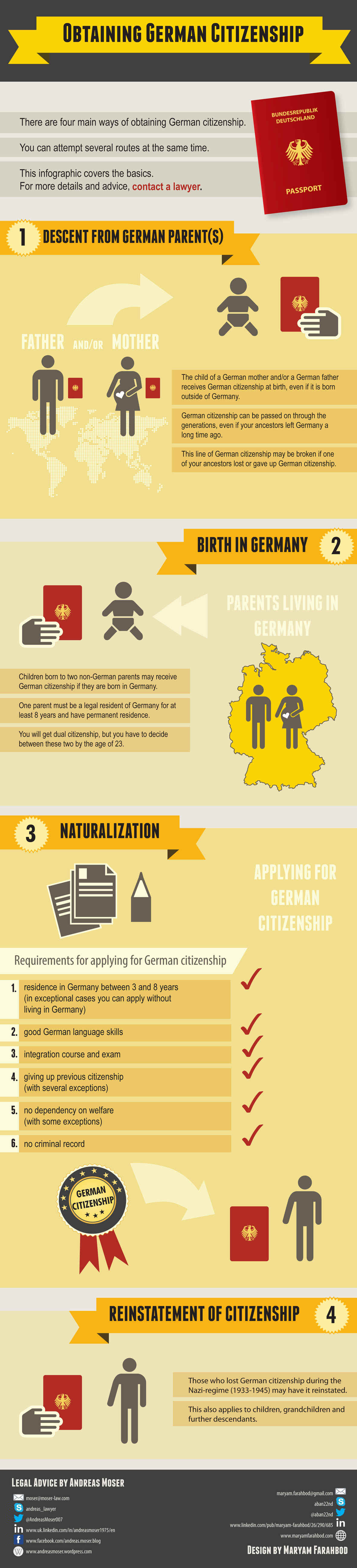
1. Does Germany have a system of ius sanguinis
or ius soli?
Germany has traditionally always been a ius
sanguinis country, meaning that citizenship is passed on to the next generation by
birth, irrespective of the place of birth. Only recently (1999) has the law been amended
to incorporate ius soli, giving German citizenship to a child born in Germany to
two parents of foreign citizenship. I will explain these different ways of obtaining
citizenship in more detail below.
2. Does ius sanguinis mean that I am
entitled to German citizenship if I have German great-great-grandparents, even if they
left Germany generations ago?
Possibly, but not automatically. You are a German
citizen under ius sanguinis if your ancestors had German citizenship at the time
of the birth of the next generation and passed on this citizenship respectively. It is
therefore necessary to find out the exact timeline of events to determine if your
ancestors might have lost their German citizenship (e.g. by giving it up voluntarily, or
by accepting a foreign citizenship) or if they still had it and could thus pass it on. You
see that this requires a lot of research into your family history and into the respective
laws of the relevant points in time. But if you are lucky, you might have German
citizenship even if your parents never knew about it and neither you or them have ever
been to Germany or even have a German passport.
3. Is there any chance to obtain German citizenship
for someone without German ancestors?
Yes. You can become a German citizen trough the ius
soli option (more about this below), through adoption by a German citizen and through
naturalization. Please note that German citizenship cannot be obtained through marriage
with a German citizen, although this does increase your chances of naturalization.
4. So what is the ius soli component of
German citizenship law?
Ius soli means the acquiring of a
citizenship based on being born in a country's territory. Germany's ius soli law
is much less far-reaching than that of the USA for example. Since 2000, a child born to
foreign parents in Germany is born a German citizen if at least one of its parents has
been a legal resident of Germany for at least 8 years and has a permanent residence status
(§ 4 III StAG). Because these children usually also receive the citizenship(s) of their
parents, they will have dual or triple citizenship. German law requires these children to
decide which citizenship they want to keep after they turn 18 and before they turn 23 (§
29 StAG). I doubt if this is in accordance with rights bestowed by the Constitution, but
these cases have not reached the Supreme Court yet.
5. Does German law allow dual citizenship?
Germany disapproves of dual citizenship, but cannot
completely prevent it, especially in cases where only one parent is German and the child
receives two different citizenships at the moment of its birth. In these cases, both
citizenships are of equal standing and nobody could be forced to give up one of them. In
cases of naturalization however, Germany requires the foreigner to give up his or her
original citizenship in order to obtain a German passport (§§ 9 I Nr. 1; 10 I Nr. 4
StAG). There are quite a number of exceptions to this requirement (§ 12 StAG), for
example if your home country does not allow you to renounce citizenship, or if the loss of
your original citizenship would result in the loss of economic rights in your home
country, and for all citizens of another EU country.
6. How long do I have to live in Germany before I
can get a German passport?
There is no mininum residency requirement. However,
as integration into German society is one of the requirements for naturalization, most
immigration authorities demand that you have lived in Germany for a few years. For the
spouse of a German citizen, this requirement is usually 3 years (of which you need to have
been married for the last 2 years). For other foreigners, it is anything between 3 and 8
years. After 8 years of residence, a German passport can no longer be denied, you have
acquired an entitlement to it (if you fulfill the other requirements, e.g. German language
skills, no criminal record, no dependency on welfare).
7. Is it possible to obtain German citizenship
although I don't live in Germany?
Yes. § 14 StAG opens this possibility if you can
show that you have close ties to Germany despite your residence in another country. Due to
the number of questions about this possibility, there is now a special set of FAQ on
naturalization from abroad.
8. How do you lose German citizenship?
There are several ways how German citizenship can be
lost (§ 17 StAG): The main cases are applying for another citizenship, renouncing German
citizenship if this does not render you stateless (§ 26 StAG) and adoption by a foreign
parent (§ 27 StAG).
9. Are there special rules for victims of the
Nazi-regime and descendants of these victims?
Yes, and this is fair because the Nazis stripped a
number of Germans of their citizenship for political, racist and anti-Semitic reasons.
These former German citizens or their descendants have a right to have their German
citizenship reinstated (Art. 116 II GG).
10. If I don't fulfil any of the legal requirements,
is there still a chance for me to get a German passport?
Do you play football very well?
FAQ
on naturalization in Germany from abroad
1. Can I become a German citizen without living in
Germany?
Yes. There are several possibilities to do so: (1)
you may already have German citizenship due to German descent, (2) re-instatement of
previously lost citizenship, (3) adoption by a German citizen as a minor, and (4)
naturalization in accordance with § 14 StAG. These FAQ only deal with naturalization from
abroad, the other options are covered in another FAQ.
2. What are the requirements to get naturalized as a
German citizen without living there?
You have to meet all the normal criteria for
naturalization. Only the requirement of residence in Germany (typically between 3 and 8
years) will be waived if you can show "ties to Germany that justify your
naturalization". I will cover these requirements in the following paragraphs.
3. Do I need to speak German?
Yes. This is an essential requirement, so don't even
apply before you have reached at least the B1 level in German. Because you would be
applying for a naturalization which you are not entitled to but which is in the discretion
of the German government, a higher level of German would be even better.
4. How do I show my ties to Germany?
There are many ways to prove these ties, and the
more ways in which you can show your ties, the better is your case: marriage to a German
citizen, employment by a German company, longer and frequent visits to Germany, ownership
of real estate in Germany for your personal use, ownership of a business in Germany,
contributions to the German pension system, visits of German schools or universities,
academic interest in Germany and anything else that you can think of.
5. What are the other requirements?
The same as with a naturalization within Germany:
(1) You need to be able to support yourself financially without recourse to welfare.
Because you would be eligible to move to and live in Germany, you need to show that you
could also earn a living in Germany. (2) You shouldn't have a criminal record. Traffic
tickets pose no problem. (3) You need to pass the citizenship test. It's a multiple choice
test about life in Germany, the German constitution and things like the colours of the
flag. You get 33 questions, of which you have to correctly answer 17 within a maximum of
60 minutes. You can take this test at a German consulate or of course on one of your
visits to Germany. All the possible questions are online, so it's easy to prepare yourself.
6. Do I need to give up my existing citizenship?
Usually yes. Germany unfortunately does not believe
in dual citizenship and thus requires applicants for naturalization to give up their
previous citizenship. There are however plenty of exceptions, but that's the topic of a
different set of FAQ.
7. When do I need to fulfil these criteria?
You need to meet these and the other criteria at the
time of the application. Because you decide when you apply, you can really prepare
yourself for such an application, even if it may take a couple of years. If you book a personal consultation,
I will assess your situation and your personal circumstances and suggest several ways in
which you can improve your chances. Of course I will also be happy to help writing your
application essay.
Once you will receive German citizenship, you don't
need to prove anything anymore. You can also keep German citizenship if you never take up
residence in Germany. Even if you would subsequently become dependent on welfare or commit
crimes, your German citizenship cannot be withdrawn.
8. How is this option connected to German
citizenship by descent?
It shouldn't be connected at all, because
citizenship by descent and naturalization are two completely different matters. But
Germany now uses this naturalization according to § 14 StAG to rectify an old problem:
Children who were born to a German mother and a non-German father before 1975 often did
not receive German citizenship by descent. This obvious discrimination against the
maternal line of descent is now being rectified by allowing these
children to apply for naturalization under this clause. The difference to
completely foreign applicants is that this group of applicants do not need to give up
their primary citizenship. Also, if you have minor children they will usually be
naturalized as well.
9. Do you have some special trick that you want to
share with us?
Always. If you work in the Iranian nuclear programme
for example and you are ready to disclose certain information to the German Intelligence
Service, your application will be viewed very favourably.
FAQ on
inheritance in Germany
1. Which law applies in international cases?
Germany applies the law of the citizenship of the
deceased (Art. 25 I EGBGB), does however allow you to choose German law for real estate
within Germany (Art. 25 II EGBGB).
2. Who inherits under German law if I have no will?
That depends on your family situation. If you have one surviving spouse and
two children for example, the spouse will receive 50 % and the children will receive 25 %
each. If you are single without children, your parents will inherit 50 % each. The more
complicated your family situation, the more complicated the distribution.
3. I don’t like these quotas. Can I determine who gets the house, the
car, my books and the dog?
Yes, you can. You will need to write a will for this purpose.
4. And how do I write a will?
The two main forms are the notarized will (which requires a notary public of
course) and the privately written will. They have equal validity.
The privately written testament has to be written by hand (no typing), signed and dated
(§ 2247 BGB).
5. Can I change my will later?
Of course. You do this either by destroying it (if there is only one copy) or
by writing a new one in which you include the explicit remark that this new will
supersedes the old one. If you have filed your will with a notary public, you need to ask
him to hand you the original testament back.
6. Can I disinherit my children / can my parents disinherit me?
German law has a system of “forced heirship” (§ 2303 BGB) which
means that children, parents and the spouse are entitled to a certain minimum of the
estate even if they are disinherited. So yes, you can express your wish to disinherit
someone in your will, but he/she will still receive a legal minimum. Only in cases of
gross misconduct on the part of the potential heir towards the deceased is it possible to
exclude them completely (§ 2333 BGB).
7. If I have been disinherited, can I contest the will?
Yes, you can (§ 2078 BGB).
8. What if I don’t want to inherit?
If you don’t want to inherit (for example if the estate includes more
debts than assets), you can refuse to accept the inheritance. However, you need to
explicitly declare that you reject the inheritance within 6 weeks of your knowledge of the
inheritance (§ 1944 I, II BGB). If you live outside of Germany, this limitation period is
6 months (§ 1944 III BGB).
9. Does Germany tax inheritance?
You bet. The tax rate depends on the amount inherited and on how closely
related you were to the deceased. As a child, for example, 400.000 EUR are tax free. Above
this threshold, the tax rate progresses from 7 % to 30 %. The maximum tax rate (for
non-related heirs) is 50 %.
10. Who inherits if there are no relatives at all and no will has been made?
Guess who? Exactly: the state in which the deceased had his last residence
will inherit everything (§ 1936 BGB).
FAQ on child
custody in Germany
1. When does German child custody law
apply?
German law applies whenever a child has
its habitual residence in Germany. The citizenship of the child and/or the parents is
irrelevant.
2. If the parents are married, who has
child custody? Does the father or the mother have stronger rights?
If the parents are married, they both
have joint or shared custody. Both father and mother enjoy exactly the same rights. The
same applies if the parents were not married when the child was born but they get married
later (§ 1626 I no. 2 BGB).
3. Can we have joint or shared custody
if we are not married?
Yes. You just need to sign a
declaration of shared custody (§ 1626 I no. 1 BGB). You can already sign this declaration
before the birth of the child (§ 1626 b II BGB), but it needs to be signed in front of a
government or consular official (§ 1626 d I BGB).
4. What are my rights as the father if
I am not married to the mother and she refuses to sign a declaration of shared custody?
There has finally been a change in the child
custody law in May 2013 and unmarried
fathers can now petition the Family Court for an order of joint custody. This petition can
only be denied if the court believes that joint custody contravenes the best interest of
the child.
5. What happens in the case of a
divorce?
Usually and in many cases: nothing.
Unless one of the parents petitions the court for a custody decision, the court will not
consider child custody. In that case, the parents will continue to have shared custody
even after the separation and the divorce.
I generally recommend to try this route
as it spares the child te necessity to appear in court and testify. (On a personal note,
both my parents continued to have shared custody for me when they divorced, so that I
never had to go attend court during their divorce. I am thankful for that.)
6. Which factors will the court
consider when deciding about custody?
The court will apply two tests: (1) Is
it in the interest of the child to end the shared custody of both parents and (2) which
parent's custody is in the better interest of the child?
If there is any chance that the parents
can still cooperate (as parents, not as spouses) in the future, the court may not wish to
award custody to one of them at all, but will instead maintain shared custody. This is
also an important factor to keep in mind if you find yourself in a custody dispute. If you
know that you are not likely to win the direct contest in the eyes of the court (typically
if you are the father of a very young child), you can petition for shared custody being
maintained. If you are very cooperative, the court will have a hard time taking away
custody from you completely.
If the court needs to make a decision
between both parents, it will consider who is better suited to take care of the child, who
has been doing this for the past, who has more time (hence the preference for non-working
mothers in many cases) and who will be more cooperative towards the other parent
(especially regarding visitation and contact and information). With increasing age of the
child, the child's wishes will also be considered.
7. What is the "Jugendamt"?
The Jugendamt is not part of the court
system, but a government agency supposed to take care of children and teenagers if their
welfare is in danger or their interests are at stake. It can be compared to CAFCASS in the
UK or Child & Youth Services in other countries.
In a custody dispute, the court will
always involve the Jugendamt and ask them to speak to the parents and the children, make
house calls and write up a report with recommendations. While these recommendations are
not binding, in reality the judge will go with them. In light of this it is especially sad
that the Jugendamt has a very bad track record when it comes to dealing with parents who
don't live in Germany. I have seen many cases myself in which the Jugendamt didn't even
bother to contact the foreign parent.
8. Can the government take away my
children?
In extreme cases, yes. (§§ 1666, 1666
a BGB). If the government thinks that your child's welfare is in danger, it can order the
removal of your child from the family as a last resort. However, you can of course appeal
against this in court. Very often, these decisions by the Jugendamt are overturned by the
Family Court because the petitioner can show that the government did not exhaust all other
possible options before taking this drastic measure.
9. What happens once my child turns 18?
Once your child turns 18, it is no
longer a child in the legal sense. Custody law no longer applies. Your child is a free
person.
10. I don't like all of this. Can I
just take my child and leave Germany?
That depends on whether you have sole
custody and/or if the other parent agrees. If both parents agree, they can always leave
Germany with their child or send the child away. If the other parent does not agree, you
have to be very careful to not commit an international child abduction.
FAQ
on filing a constitutional complaint in Germany
1. I feel that my human rights have
been violated in or by Germany. Can I seek redress against this?
Yes. Everyone can file a constitutional
complaint ("Verfassungsbeschwerde") with the Supreme Court
("Bundesverfassungsgericht") if the appellant believes and argues that his/her
fundamental rights have been violated by an act of the German executive, by a German court
order or by a German act of parliament.
2. What are these fundamental rights
that I have in Germany?
They are all the fundamental rights
enumerated in Art. 1 through 19 of the Constitution ("Grundgesetz" [GG]) as well
as the rights mentioned in Art. 20 IV, 33, 38, 101, 103 and 104 GG.
Some of these, like freedom of assembly
(Art. 8 I GG), freedom of association (Art. 9 I GG), freedom of movement (Art. 11 I GG),
the protection against removal of German citizenship and others, are citizens' rights and
are only applicable if you have German citizenship.
Other rights, like human dignity (Art.
1 I GG), equal protection (Art. 3 I), equality between men and women (Art. 3 II),
protection from discrimination (Art. 3 III), freedom of religion (Art. 4 I), free speech
(Art. 5 I) and many others, are human rights and you can also invoke them if you are not a
German citizen.
3. How hard or easy is it to file such
a constitutional complaint?
Theoretically it's very easy. You don't
need to be represented by a lawyer, you can write the complaint yourself and the court
charges no fees (except in frivolous cases).
What is hard however is to file a successful
complaint. The Supreme Court receives thousands of constitutional complaints every year.
In 2011, only 1.62 % of these were successful.
4. Why are the chances of success so
small?
For one, many of the constitutional
complaints don't have any merit. If you are thinking of not paying taxes and and want to
base this on "freedom of religion" (Art. 4 I GG) because you founded your own
cult which does not believe in paying taxes, don't waste your time bothering the court. If
you have been convicted of a crime and are appealing your prison sentence for violation of
your "freedom of movement" (Art. 11 I GG), save yourself the time.
Second, there are a whole number of
formal requirements, some of them easier, some of them quite complicated, that need to be
met in order for your complaint to even qualify for the judges to read through it.
5. What are the formal requirements for
the constitutional complaint?
There are plenty and I can't go into
all of them here. I will list the ones that usually cause the complaints to fail or that
cause me to dissuade a client from filing a constitutional complaint:
(a) You can only seek remedy against
acts of the state. If your human rights have been violated by a company, by a private
individual or by your spouse, you have to address this to the civil courts.
(b) The constitutional complaint is the
last resort. You need to have exhausted all other remedies and appeals before addressing
the Supreme Court. If you are not happy with a verdict of a Family Court or a Criminal
Court, you need to file the regular appeal(s) first. If you don't like that the police
ordered you to do something, you need to sue them in the Administrative Court first, then
go through the appeals and then you can finally address the Supreme Court. Because of
this, the Supreme Court usually hears cases years after the underlying situation actually
occurred.
(c) The constitutional complaint needs
to include all the necessary information and documents to enable the Supreme Court to
decide the case. You need to point out which of your constitutional rights has or have
been violated and you need to explain how they have been violated. You need to show what
attempts you have made in the lower courts to seek redress against this problem.
6. Is there a deadline for filing the
constitutional complaint?
Yes. It is one month from the time of
the last court order, usually the denial of your last appeal. One month is a short time to
put together a solid and well-written constitutional complaint, so you better contact me
or another lawyer as soon as possible.
7. Is the Supreme Court another Appeals
Court?
No. Absolutely not. The Supreme Court only
looks at whether your constitutional rights have been violated. It does not supplement the
lower courts' decisions with its own decision. The Supreme Court may think that the lower
courts were wrong in evaluating the facts, that they miscalculated damages, that a
sentence was too harsh, that a decision should have been issued differently from the way
it was, but all of this is irrelevant, as long as it does not touch on your constitutional
rights.
It is therefore imperative to limit the
constitutional complaint to matters constitutional and not attempt to retry the whole case
once more.
8. Are there any other constitutional
complaints in Germany?
Yes. Germany is a Federal Republic and
thus each of the 16 states has its own Constitutional or Supreme Court. 10 of these states
allow constitutional complaints. Baden-Württemberg just introduced this possibility and
it will be available from April 2013 on. Before the State Supreme Court, you can only
claim your rights under the State Constitution. Most of the basic rights are however very
similar to those in the Federal Constitution.
9. Can I go to the European Court of
Human Rights instead?
It depends on the specific case, but
usually no. Or more presicely: not yet. The European Court of Human Rights (ECtHR)
requires that you have exhausted all possible remedies in national law, including the
German constitutional complaint. Thus, if you do not address the German Supreme Court
before and await its decision, your human rights complaint will be dismissed by the ECtHR
in Strasbourg on formal grounds.
10. Can you help me with my case?
Sure. I can determine if your case has
any merits and if you then decide to go ahead, I'll be happy to write the constitutional
complaint for you.
FAQ on
freedom of movement within the EU
1. What is the right to freedom of movement within
the European Union?
Broadly speaking, the citizen of any EU member state
can move to any other EU member state without a visa, a residence permit or any other
formality being required. It's as easy, and in some cases easier than, a move within a
country's borders.
2. Is this what people call Schengen?
No, these are two completely different things.
Schengen is a system for the abolishment of physical borders and for a single tourist visa
for 26 countries. The UK, Ireland, Bulgaria, Romania, Croatia, Cyprus are not part of
Schengen (but with the exception of the UK and Ireland will be sooner or later) but are
bound by the EU freedom of movement rules. Even more confusingly, some countries which are
not in the EU are part of Schengen and the freedom of movement rules also extend to them
(Norway, Liechtenstein, Iceland). The situation in Switzerland is even more complicated,
but please ask a Swiss lawyer about that.
3. Are you allowed to work or study in any other EU
country?
Yes, freedom of movement not only means that
you can travel, but you can settle in any EU country. You can take up employment, you can
study, you can set up a business, you can retire. You can pretty much do anything that you
can do in your home country, with exceptions on some government jobs which may be
restricted to nationals of that country and on voting in national elections.
4. Is there a limit as to how long you can stay in
another EU country?
You are always allowed up to three months in any EU
country without any further conditions. For stays beyond three months, you must be
exercising one of your EU Treaty rights, i.e. being in employment, running a business,
studying or being self-sufficient. This is a gross simplification, but as long as you
don't apply for welfare, you are safe. In reality, the three-month rule is not enforced,
also because you could leave the country and come back the next day or you can always say
that you just arrived yesterday because your passport doesn't get stamped if you cross the
border as an EU citizen. - From my personal experience, nobody cares. I have been living
in six different EU countries and never had any kind of registration, paperwork, nothing.
It was never a problem.
5. How does this help me as a non-EU citizen?
Now we're getting to the interesting part! EC directive 2004/38 extends the freedom of movement
rights to family members of EU citizens. That means that if you are
Afghan/Brazilian/Chinese or anything else and your spouse is an EU citizen, then you can
live with them in the EU if they are exercising their freedom of movement rights, i.e. if
they are not living in their country of citizenship.
6. That's great! How do I get this EU freedom of
movement visa?
It gets even better: you don't need any visa.
Freedom of movement is a right which you have by virtue of law and it does not depend on
any EU member state issuing a visa or a residence permit. When travelling or crossing
borders together with your EU spouse, you just need to bring your marriage certificate and
you'll be able to enter the EU or cross borders within the EU.
If you want, you can however apply for a residence
card which will show that you have the right to reside in that particular country. This is
NO legal requirement and you have the right to stay BEFORE you apply or obtain such a
residence card. The practical use of the card is for employers (who often don't understand
immigration law) and to show to border guards (dito) and airline staff (dito).
7. Wait. I heard that some countries have
restrictions for the immigration of spouses.
Yes, Germany for example requires a minimum
knowledge of German, the UK requires a certain income level. But these national rules do
NOT apply to other EU citizens and their spouses because national law cannot overrule EU
law. This leads to the paradoxical situation that it is easier to migrate to an EU country
if you are married to the citizen of another country than to a citizen of that country.
For example: If you are a non-EU citizen and you get married to a German and want to move
to Germany, you will need to prove minimum language skills in German and you will need a
visa; but if you marry a French person who lives in Germany, you can move to Germany
without a visa and without any language skills because you fall under EU law.
8. I have the feeling that you were about to suggest
a trick.
Of course! Thanks to the freedom of movement in the
EU and the fact that there are no more border controls between most countries, you can
bypass national immigration laws. Let's say we have a German guy who gets married to a
woman from Bangladesh, but she cannot get a German visa. Easy: the German husband moves 5
km across the border to France, Poland or any other neighbouring EU country, and the wife
can join him right away. Officially they will live in France, Poland etc. but as there are
no border controls, nobody will know how much time they spend where.
9. You keep talking about spouses, but does this
also relate to other family members?
Yes, it does. Other groups of family members who may
benefit from the freedom of movement in the EU are: same-sex partners, unmarried long-term
partners, children, dependent parents, including dependent children and parents of the
non-EU partner. You may notice that this is the perfect loophole for circumventing strict
national laws against family reunion.
10. And all these rules are the same in every EU
country, so it doesn't matter if my spouse is from Germany or from Croatia?
No. That would be too simple. EC Directive 2004/38
needs to be transposed into national law and this leads to slightly different results in
each of the 28 EU member states. A particular problem arises for same-sex partners because
some EU member states haven't recognized such partnerships (yet).
Usually, the country of citizenship of your spouse
or sponsor is not as relevant as the country in which you wish to settle. For Croatian
citizens however (and thus for non-EU family members of Croatian citizens), some countries
(for example Germany) have opted to use a phasing-in which limits access to the labour
market before July 2015. There are however no limits on moving as a student or on setting
up a business or being self-employed, so that these limits can be easily circumvented.
Because this is a very complicated area of the law,
I ask you to restrict your questions in the comment section to general questions which
might be of interest to others. I won't be able to solve specific, complicated cases
without looking at the details and not without charging. Please feel free to contact me
directly and be as precise as possible in the description of your case. I charge 250 EUR
for a detailed consultation. And remember (I have to mention this explicitly because it
happens almost every day), I cannot answer questions if you write to me saying "I am
an EU citizen and my wife is a non-EU citizen". I need to know exactly all types of
citizenship involved.
FAQ on
working with me as your lawyer
1. Is it true that you are on sabbatical?
Yes. I took a break from lawyering in August 2009
after having worked as a lawyer for 7 years. I wanted to pursue some of my other interests
and to travel more. I have since even found the time to complete an MA in philosophy.
2. When will you be back?
Probably not for a few more years. If you follow my blog, you
will be the first to know once it happens.
3. Is there no chance you can help me with my
question?
The point of my sabbatical is to work less, so I
cannot reply to all the requests I continue to receive.
But there are two ways you can try to tap my
knowledge: I answer some questions for free on All Experts (see question no. 4) and sometimes I might do some
extra work for really nice people (see question no. 6 et seq.).
4. What do I have to do to get my question answered
for free?
I am one of the experts for German Law on All
Experts. You go to this website: www.allexperts.com/ep/1364-118581/German-Law/Andreas-Moser.htm
and click on "Ask a Question".
Please note that I answer a maximum of one or two
questions per day. If you fail to read through these FAQs or my previously answered
questions on All Experts and ask a very basic or repetitive question, I might decline to
answer your question. I also won't answer questions marked as "private" because
the purpose of that website is to educate the public and others who might be in a similar
situation to yours.
5. How can I thank you adequately for this free
service?
I have a wishlist of books (and
another
one for German language titles) and I would appreciate if you choose and mail me one
of the books. Getting quality legal advice for free should be worth such a relatively
small effort, right?
6. Would you also be available for more individual
questions or more legal help?
I might. From time to time, I will accept a case on
a freelance basis.
Please note that I am currently not admitted to the
bar as an attorney, so I cannot officially represent you in most court cases. I can of
course give general advice, strategic advice, draft letters and briefs, perform legal
research and legal translations.
7. Do you charge for this?
Of course. For an initial consultation, whether by
phone, e-mail or in person, I charge 200 € or the equivalent in your currency. The
easiest way to pay is through PayPal.
The consultation will be thorough and in-depth. It
will draw not only on my legal knowledge but also on my vast trial and strategic
experience. I will set aside several hours of my time to answer all of your questions.
If we decide to proceed together after the initial
consultation, we will agree on the fees for that.
8. How can I contact you?
The best way is to send an e-mail to moser@moser-law.com and
provide a detailed account of your situation, preferably pointing out that you have
already read these FAQ and haven't found the answer therein. You can also contact me on
Skype at "andreas_lawyer".
9. Can you recommend any other lawyer in Germany?
No, unfortunately not. But I have put together the 10 ultimate guidelines for finding
the best lawyer.
(C) Andreas Moser. www-moser-law.com. moser@moser-law.com.